

Browse by Series
View reports and briefs by research series, including Productivity & People, Talent Reimagined, Entry-Level Jobs, and the Evergreen Model.
Series 1: Productivity & People
Series 1’s six reports reveal how people drive labour-market productivity, charting policy paths to unlock the full potential of both our learning ecosystem and every individual. Click HERE to see all of Series 1’s reports.
Explains Canada’s productivity challenge and why human capital — people’s skills, capabilities, learning, and experience — must be part of the solution.
Identifies the major forces reshaping work, skills, and regional labour markets, and why Canada needs stronger systems for workforce adaptation.
Reframes talent development as a human capital supply chain that connects learners, educators, employers, credentials, and labour-market demand.
Maps the wider learning ecosystem and shows how certified, non-certified, informal, and workplace learning can better support productivity.
Explains why hiring is a risk-management problem and how better signals of capability can improve employer confidence and opportunity.
Outlines policy tools for opening learning systems, improving recognition, and helping people build and demonstrate capabilities across their careers..
Series 2: Talent Reimagined
Series 2 charts a decade-long policy roadmap to unlock human capital—introducing a transformative open learning architecture with learners at its core, delivered across 10 in-depth reports. Click HERE to see all of Series 2’s reports.
Presents the full open learning architecture for building a more flexible, learner-centred, competency-based human capital system.
Introduces the case for lifelong open learning and explains why traditional education systems are not enough for a changing economy.

Applies the open learning architecture to Alberta and imagines how the province could build a lifelong learning system by 2036.
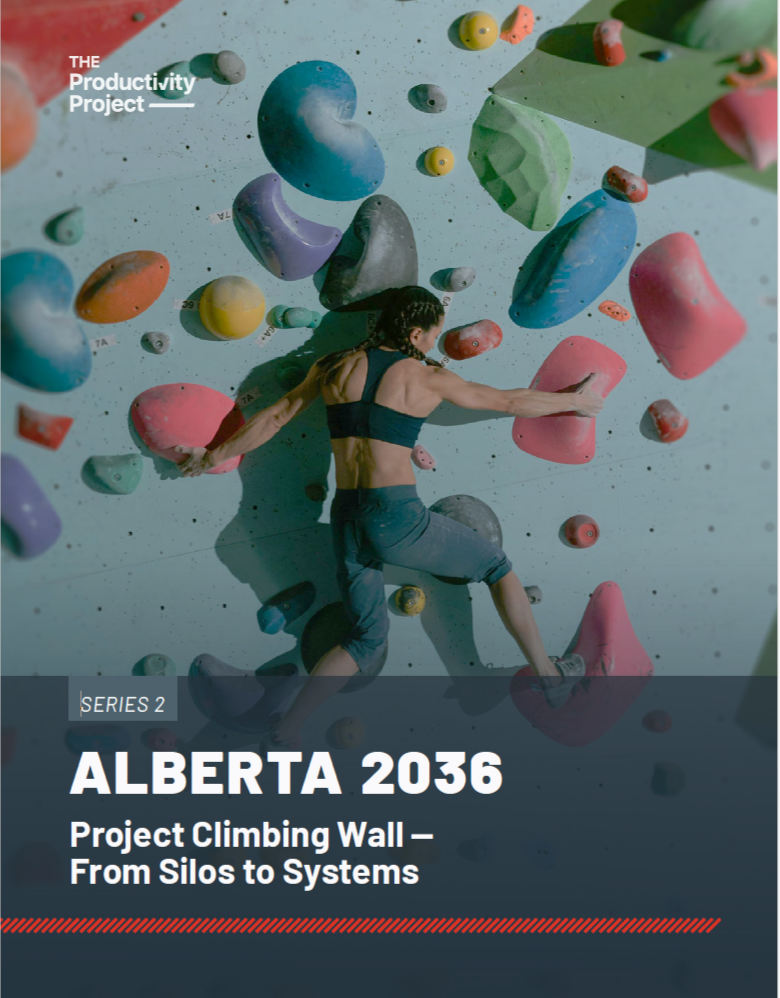
Uses the climbing wall metaphor to show how people need multiple routes, entry points, and supports to move through learning and work.
Focuses on the learner and proposes tools that help people navigate learning, verify capabilities, find mentors, and access funding.
Reimagines the campus as a more open public platform that supports lifelong learning, community access, and workforce development.

Examines the deeper system shift needed to move from institution-centred education to learner-centred, capability-based development.

Explores how Alberta could communicate, promote, and build public trust in a new open learning and human capital system.
Uses future stories to make the open learning architecture concrete, showing how learners, employers, and providers could experience change.

A narrative companion piece that explores how learning systems can either close doors or create new possibilities for people.
Series 3: The End of Entry-Level Work
For any young person, landing your first real job has always been tough, but now the bridge from school to work is collapsing. Series 3 exposes the breakdown and policy paths to rebuild this key transition. Reports 1 and 2 have been released. Reports 3-5 will be released in Fall 2026. Click HERE to see the available Series 3 reports.
Explains why the decline of entry-level work is an early warning sign for Canada’s ability to turn learning into opportunity.
Shows how AI is changing the junior tasks that once helped new workers build skills, confidence, networks, and experience.
This study explores the impact of remote and hybrid work on developing early career workers and the broader implications to the labour market.
Coming Fall 2026.
Coming Fall 2026.
Series 4: The Evergreen Model
Today’s volatile labour market isn’t an anomaly—it’s driven by rapid skill depreciation. To compete, Canada needs a learning architecture that makes adaptive capability the core workforce skill. Click HERE to see the available Series 4 reports.
Evergreen by Design introduces the Evergreen Model, an architecture for understanding how different forms of human capability retain, lose, renew, and demonstrate value as labour markets change.
Explains why some skills lose value quickly, some remain useful over time, and others regain value as conditions change.
A lush green forest with a small waterfall cascading over rocks, sunlight filtering through tall trees.